Why does crimp make wool work in a pillow?
Updated .
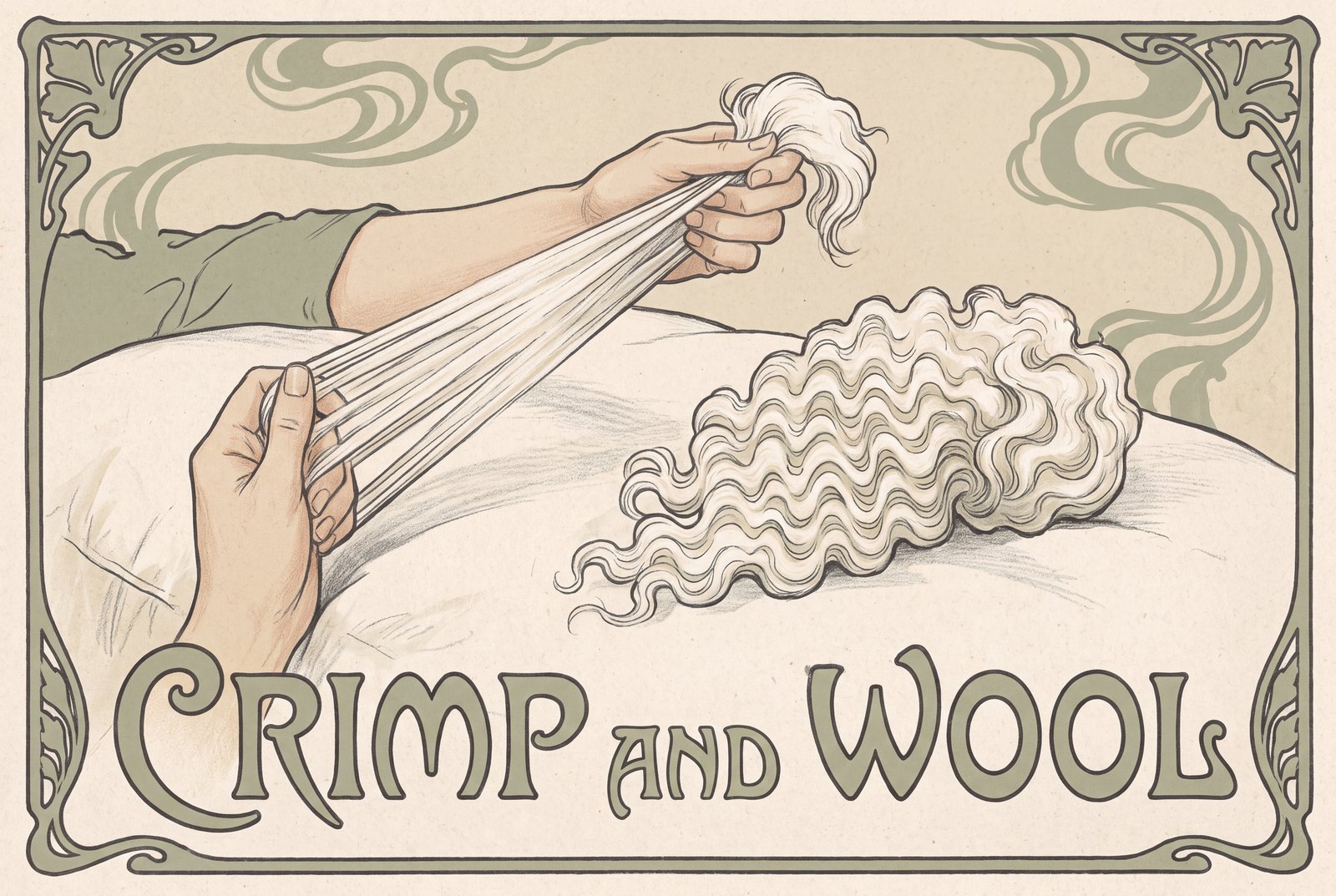
Pinch a tuft of raw wool, pull it straight and let go. It jumps back into a tight zigzag. That zigzag is crimp. It decides whether a wool pillow keeps holding your head up or slowly sinks into a flat pad.
Short answer: Crimp is the natural wave along each wool fiber. The waves hold fibers apart, trap air and act like small springs, so a pile of wool pushes back when your head presses into it. Finer wools carry more waves per inch, while coarse longwools average only 3 to 6 (SweetGeorgia Yarns). In one fill patent, raising crimp from 3.5 to 6.0 per inch gave about a fifth more push-back (US fill patent).
This guide is for: people choosing a wool pillow who want to know why some stay full and others go flat, and what to ask a seller before paying.
Key Takeaways
Three points carry most of the weight: what crimp is, what it does under your head, and how rarely sellers put a number on it.
- Crimp is a spring you can count. Graders measure it in crimps per inch, and finer grades usually carry more of them. Coarse longwools average only 3 to 6 per inch (SweetGeorgia Yarns). The waves hold fibers apart, and the air in those gaps is what pushes back under your head.
- More waves means more push-back. A polyester fill patent reports results for one fiber at two crimp levels. Raising crimp from 3.5 to 6.0 per inch lifted resistance to compression from 1.75 to about 2.15 lb (US fill patent). Wool gets that extra push-back from the way it grows.
- Sellers rarely give you the figure. Of 8 US wool pillow pages we read on September 26, 2026, 2 used the word crimp and none stated a crimp count or fiber diameter. You fill that gap by asking for the breed, the grade and the fill weight.
On This Page
Eight questions, in the order a buyer tends to ask them, from what crimp is to how to judge it before you pay for a pillow.
What is crimp in a wool fiber?
Crimp is the natural wave along a wool fiber, grown in by the follicle, and graders count it in crimps per inch to judge the wool.
Crimp is the regular ripple you see along a lock of wool when you hold it up to the light. An Australian university wool textbook treats crimp as part of how wool grows, influenced by breed and nutrition (Woolwise). So feeding shapes it as well as genetics. US wool judges rely on it too. South Dakota State University Extension says crimp is one of the signs used to read a fleece's grade, and that locks with more crimps per inch tend to be finer (SDSU Extension).
Why does a fiber grow bent at all? The usual explanation is that 2 types of cell inside the fiber grow side by side at different rates, and the mismatch bends it (Woolmark). A study of sheep skin points to a different cause. Uneven cell division in a curved follicle explained most of the variation in fiber curvature, and the ratio of the two cell types showed no link at all (PubMed abstract).
You do not need to settle that debate to buy a pillow. The useful fact is simpler. Natural crimp is grown, so it varies from sheep to sheep. Two pillows both sold as pure wool can hold your head up very differently. What wool fill is covers the fill itself if you want the basics first.
Why does crimp make wool springy in a pillow?
Each wave works like a small spring and holds fibers apart, so a mass of crimped wool traps air and pushes back when your head presses in.
Picture a heap of perfectly straight fibers. They slide together and lie flat, like dry spaghetti in a box, and your head sinks right through them. Crimped fibers cannot pack that closely. Their waves prop their neighbors apart, hold air in the gaps and bend instead of breaking when pressed.
A recent review of wool science says crimp adds bulk, springiness under compression and stretch to the fiber (MDPI Animals). Wool scientists call the push-back resistance to compression: the force per unit area needed to squeeze a fixed weight of wool into a fixed volume (Woolwise). In superfine Australian wool it depended on crimp frequency more than on fiber diameter (ResearchGate review table).
Polyester fill makers copy the effect on purpose, which is good evidence that the wave does the work. One fill patent reports results for one polyester fiber at 2 crimp levels:
| One polyester fiber | Crimps per inch | Resistance to compression |
|---|---|---|
| Lower crimp | 3.5 | 1.75 lb |
| Higher crimp | 6.0 | about 2.15 lb |
Source: US fill patent. More waves gave roughly a fifth more push-back with nothing else changed. Wool grows its waves without a factory, and you feel them every time you lie down.
How much crimp do different wools have?
Finer wools carry more crimps per inch and coarse longwools far fewer, and some springy middle grades are classed as suited to bedding.
Crimp follows fineness, but only loosely. The Woolwise textbook notes that crimp was once treated as a reliable guide to diameter, and that this does not always hold (Woolwise). Use the table as a rough map.
| Wool type | Fiber diameter | Crimp | Our judgement for a pillow |
|---|---|---|---|
| Finest grades | The finest end of the grading scale | More crimps per inch than coarser wool (SDSU Extension) | Plenty of spring. Softness matters less inside a cotton case |
| Downs breeds (Southdown, Suffolk) | Not stated by the source | Spongy staple, classed as suited to bedding (AWEX) | The one type a wool exchange points at bedding. Ask for it by name |
| Fine crossbred | about 27 micron (AWEX) | Fewer crimps than the finest grades | A middle ground. The stiffer fiber may help hold height |
| Longwools | 24 to 41 micron | 3 to 6 per inch (SweetGeorgia Yarns) | Heavy and lustrous, with less spring per pound |
We wrote the last column ourselves. It reasons from grading data, and nothing here was tested. Resistance to compression is a trade measure, built in Australia to tell its wool types apart (Woolwise). What it tells you: breed and grade say more about spring than the word "wool" on a label. If a seller names a Downs breed or a crossbred grade, you have learned something useful about the fill.
Does more crimp always mean a better pillow?
No. More crimp adds spring per ounce, but fiber stiffness, fill weight and how the wool is processed all change how a pillow feels and lasts.
Resistance to compression depends on fiber diameter as well as on the frequency and form of the crimp (Woolwise). A thin, very wavy fiber and a thicker, gentler one can end up pushing back with similar force. Softness pulls the other way. The softest sweater wool is prized for how it feels on skin, and inside a cotton case you will feel little of that. So the softest wool is not automatically the springiest pillow wool.
Fill weight changes the feel as much as the fiber does. One Michigan mill fills a standard 20 by 26 inch pillow with 1.6 lb of wool (Frankenmuth Woolen Mill). A New York maker puts 2 lb into a standard pillow (Cece's Wool). Crimp sets how springy each ounce is, and weight sets how many ounces your head rests on.
This advice is our judgement. Look for medium-grade wool with clear, even waves, then choose the fill weight to match how you sleep. One seller builds its thinnest pillow for people who sleep on their stomach and a fuller one for people who sleep on their side or back (Holy Lamb Organics). You will get more from matching weight to position than from chasing the highest crimp.
What is the difference between natural and machine crimp?
Natural crimp is grown by the sheep. Machine crimp is pressed into straighter fiber at the mill, and sellers disagree about which lasts.
Natural crimp grows into the fiber. Machine crimp is pressed in at the mill, usually to give straighter wool more bulk. Pillows sold in the US use both.
One seller says its New Zealand wool goes through a crimping process that gives more volume without added weight (Turmerry). Another seller's blog takes the opposite view. It says most New Zealand sheep grow long, straight wool with little crimp, and that the best wool bedding uses naturally crimped fiber (The Futon Shop). Neither page shows test data, so treat both as claims.
Polyester gives a clue to how a pressed wave can last. In synthetic fill the wave is heat-set, and one fill patent says heat-setting "helps establish the memory of the fibers to spontaneously curl" (US fill patent). None of the seller pages we read gave figures on whether a pressed wave in wool lasts as long as a grown one.
So ask the seller directly. One that knows whether its crimp is natural or mechanical, and where the wool came from, has looked closely at its own fiber. You can judge the rest from how clearly it answers. A vague reply tells you something too.
Do wool pillow sellers tell you about crimp?
Rarely with a number. We read eight US wool pillow pages; two used the word crimp, and none gave a crimp count or fiber diameter.
Our count: On September 26, 2026, we read the product pages of 8 wool bed pillows sold in the US, found by search, and sorted each one by what it says about the fiber. This is a count of published words only. It tells you nothing about how any of these pillows feels.
| What the page says about the fiber | Pages | Which pages |
|---|---|---|
| Uses the word crimp | 2 | Naturepedic, Turmerry |
| Claims spring or resilience, never says crimp | 2 | Cuddle Ewe, Sachi Organics |
| Gives origin, certification or fill weight only | 4 | Holy Lamb Organics, Frankenmuth Woolen Mill, The Futon Shop, Cece's Wool |
The 2 crimp pages use the word in different ways. Naturepedic credits crimped wool fibers with responsive support, while Turmerry describes crimping its wool during processing. Cuddle Ewe credits a blend of sheep breeds for its resilience. The largest group tells you where the wool came from or how many pounds went in.
None of the eight gave a crimp count, a micron figure or a resistance-to-compression value in the text we read. Pages change, and a figure could sit in a spec sheet we did not see. An organic claim does not fill the gap either, because it covers farming and processing and says nothing about spring, as What makes a wool bed pillow organic, and is it worth paying for? explains.
Why does a wool pillow lose height over time?
Nightly weight and moisture slowly pack and tangle the fibers, so your pillow sits lower each month unless you open it and fluff it.
Every wool pillow gets lower. One maker states that pillows built from wool layers can settle by 15 to 30% in the first few months of use (Holy Lamb Organics). Sellers often call a pillow's fullness "loft"; this guide says height. For you, that means a pillow that fits your neck on day one may sit too low within a season unless you add fill.
Two things work against the waves. The first is plain packing: each night presses the fibers closer, and some never spring fully back. The second is felting. Wool's surface scales hook together when the fibers are rubbed or agitated, which locks them into a denser mat (Wikipedia). Crimp slows both but does not stop either.
The fiber is tough. Wool can bend back on itself many thousands of times without breaking, far more often than cotton can (MDPI Animals). So a flattened wool pillow more likely has packed or tangled fibers than broken ones.
Sellers disagree on care. One mill says sunning a pillow revitalizes the wool (Frankenmuth Woolen Mill). Another warns that "High heat and strong sunlight can dry out wool fibres", and says the fiber needs some moisture to stay springy (Soul Comfort). A zippered pillow lets you open it, tease the clumps apart by hand and add fill as it settles. That works with the fiber.
How can you judge crimp before you buy a wool pillow?
Ask the seller for breed or grade, natural or machine crimp, and fill weight in pounds, and if you can, pull a tuft and watch it spring back.
The 4 direct questions below will tell you a lot. If the pillow has a zipper, your own fingers can tell you more. Pull a small tuft, stretch it and let go. Wool with good crimp snaps back into waves, while limp wool stays stretched out. It is a rough check, but it shows you the property this whole page is about.
| Ask the seller | An answer that tells you something | An answer that tells you little |
|---|---|---|
| What breed or grade is the wool? | A breed, a micron figure or a grade such as 56s | Only "premium" or "eco" wool |
| Is the crimp natural or pressed in? | Either one, stated plainly | No answer |
| How much fill is in a standard pillow? | A weight in pounds | Only soft, medium or firm |
| Can I open it and add fill? | A zipper and spare wool on offer | A case sewn shut |
The questions matter more than any single answer. A seller that can name the grade has likely chosen it on purpose. A seller that offers spare fill expects you to top up as the pillow settles, which matches how wool behaves. Price and whether wool suits you at all are covered in Is a wool pillow worth it, and how do you choose one?, so you can weigh crimp against everything else on your list.
Common questions
Short answers to the questions people ask most often about crimp, wool grades, machine crimping and why wool pillows flatten over time.
Is crimp the same as curl?
No. Crimp is a regular wave along a single fiber, and wool judges count it per inch (SDSU Extension). Curl usually describes a whole lock twisting. Some longwools grow bold, curling locks with only 3 to 6 crimps per inch (SweetGeorgia Yarns).
Do all sheep grow crimped wool?
No. The amount of crimp depends on breed and even on feed (Woolwise). Hair, unlike wool, has no crimp (Wikipedia). That spread is why the breed matters when you buy wool fill.
Does softer wool make a better pillow?
Not always. The finest grades carry the most crimp per inch, but their main selling point is softness against skin, and inside a cotton case you feel little of that. Australia's wool exchange classes spongy Downs-breed wool as suited to bedding (AWEX).
Can you bring crimp back in a flat wool pillow?
Partly. You cannot regrow the wave, but you can undo some of the packing. Open the case, pull the clumps apart by hand and air the wool. If it has felted into a mat, adding fresh fill is the practical fix.
Does washing ruin a wool pillow's crimp?
The risk is agitation while wet, because that drives felting. Wet wool fibers can stretch a long way and still recover (MDPI Animals), but tumbling wet wool mats it. Several of the pages we read mark the insert spot clean only.
Why does polyester fill have crimp too?
Straight synthetic fiber would pack flat, so fill makers press waves into it and heat-set them. The US fill patent reports that raising crimp from 3.5 to 6.0 per inch, with the fiber unchanged, gave more resistance to compression. It is a manufactured copy of what wool grows naturally.
Sources
Here are the pages, papers and shops this wool guide draws on, each named beside the question it answers.
- SweetGeorgia Yarns (sweetgeorgiayarns.com), drawn on in “Key Takeaways”; “How much crimp do different wools have?”; “Common questions”.
- US fill patent (image-ppubs.uspto.gov), drawn on in “Key Takeaways”; “Why does crimp make wool springy in a pillow?”; “Common questions”.
- Woolwise (woolwise.com), drawn on in “What is crimp in a wool fiber?”; “Why does crimp make wool springy in a pillow?”; “How much crimp do different wools have?”; “Does more crimp always mean a better pillow?”; “Common questions”.
- SDSU Extension (extension.sdstate.edu), drawn on in “What is crimp in a wool fiber?”; “How much crimp do different wools have?”; “Common questions”.
- Woolmark (woolmark.com), drawn on in “What is crimp in a wool fiber?”.
- PubMed abstract (pubmed.ncbi.nlm.nih.gov), drawn on in “What is crimp in a wool fiber?”.
- MDPI Animals (mdpi.com), drawn on in “Why does crimp make wool springy in a pillow?”; “Why does a wool pillow lose height over time?”; “Common questions”.
- ResearchGate review table (researchgate.net), drawn on in “Why does crimp make wool springy in a pillow?”.
- AWEX (sasheepexpo.com.au), drawn on in “How much crimp do different wools have?”; “Common questions”.
- Frankenmuth Woolen Mill (wool-bedding.com), drawn on in “Does more crimp always mean a better pillow?”; “Do wool pillow sellers tell you about crimp?”; “Why does a wool pillow lose height over time?”.
- Cece's Wool (ceceswool.com), drawn on in “Does more crimp always mean a better pillow?”; “Do wool pillow sellers tell you about crimp?”.
- Holy Lamb Organics (holylamborganics.com), drawn on in “Does more crimp always mean a better pillow?”; “Do wool pillow sellers tell you about crimp?”; “Why does a wool pillow lose height over time?”.
- Turmerry (turmerry.com), drawn on in “What is the difference between natural and machine crimp?”; “Do wool pillow sellers tell you about crimp?”.
- The Futon Shop (thefutonshop.com), drawn on in “What is the difference between natural and machine crimp?”.
- US fill patent (image-ppubs.uspto.gov), drawn on in “What is the difference between natural and machine crimp?”.
- Naturepedic (naturepedic.com), drawn on in “Do wool pillow sellers tell you about crimp?”.
- Cuddle Ewe (cuddleewe.com), drawn on in “Do wool pillow sellers tell you about crimp?”.
- Sachi Organics (sachiorganics.com), drawn on in “Do wool pillow sellers tell you about crimp?”.
- The Futon Shop (thefutonshop.com), drawn on in “Do wool pillow sellers tell you about crimp?”.
- Wikipedia (en.wikipedia.org), drawn on in “Why does a wool pillow lose height over time?”; “Common questions”.
- Soul Comfort (soulcomfortsheepskin.com), drawn on in “Why does a wool pillow lose height over time?”.