What makes a wool bed pillow organic, and is it worth paying for?
Updated .
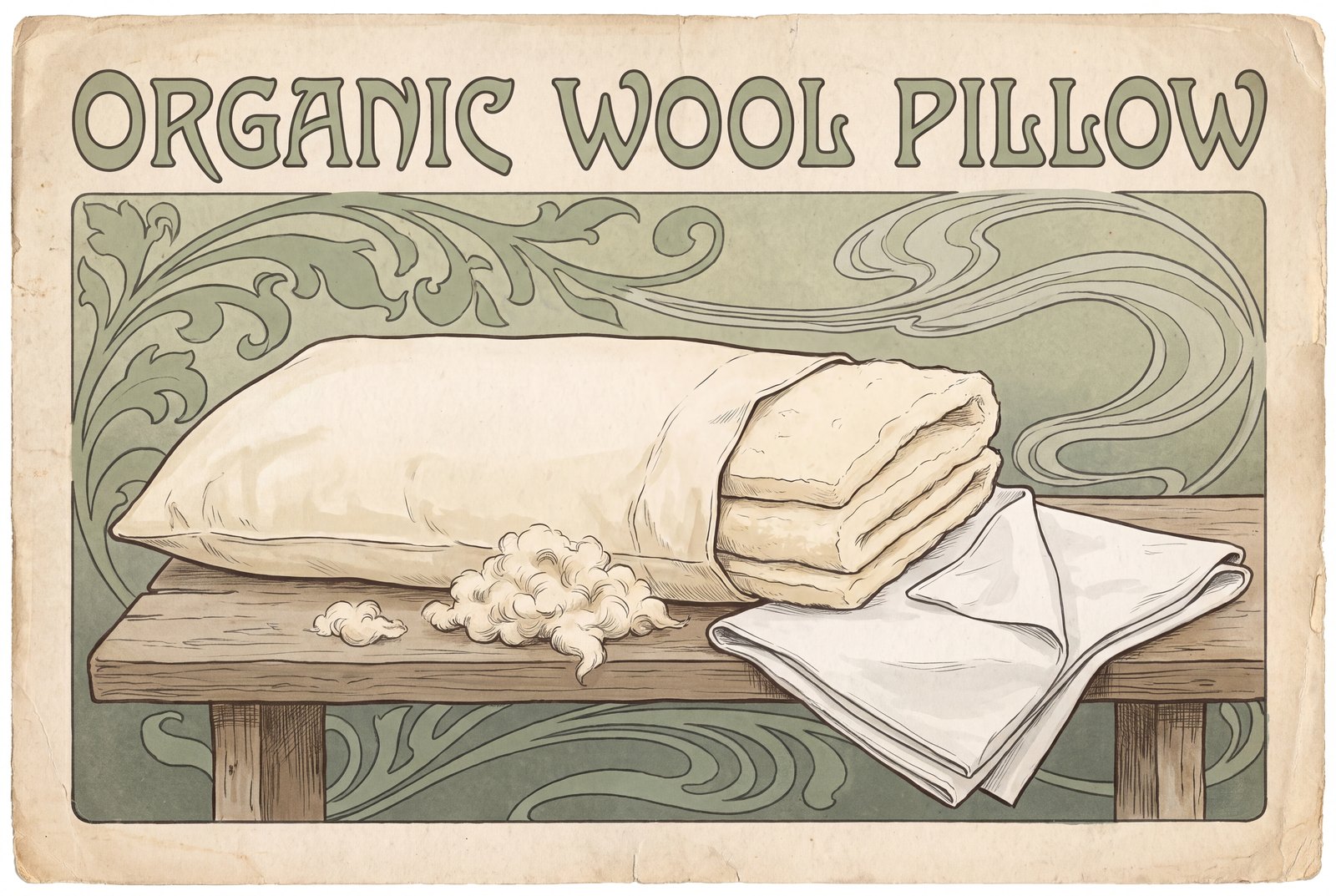
An organic wool bed pillow is a finished pillow certified organic, with organic wool inside. On a product page, though, "organic" can describe the case, the wool, or both. When we read 6 US seller pages for this guide, only 1 said the finished pillow was certified organic with organic wool fill, and 5 used the word only for the cotton case.
Short answer: An organic wool pillow is worth buying if you want a dense pillow that breathes and you can live with spot cleaning. Pay the organic premium only when the page says the finished pillow is certified organic with organic wool inside, not just that the case is organic cotton. The standard pillows in our count hold about 20 to 33 oz of wool (Organic Bed & Baby, Eartheasy), and sellers expect them to settle by about a third (Frankenmuth Woolen Mill).
This guide is for: people in the United States choosing a wool bed pillow or body pillow who want to know what the organic label proves before they pay for it.
Key Takeaways
Three points hold across the standards and seller pages we read. Each one changes what you should check before paying for organic wool.
- Check the fill, not the case. Of 6 seller pages we read, 1 said the finished pillow was certified organic with organic wool inside, and 5 called only the cotton case organic.
- "Made with organic materials" is the lower grade. A product under that GOTS grade needs only 70% certified organic fibre, against 95% for the plain "organic" grade (Specialty Fabrics Review).
- Expect about a third less height. Eartheasy describes about 30% compression and Frankenmuth about one third (Eartheasy, Frankenmuth Woolen Mill), so if you want to add wool back later, get a pillow with a zipper.
On This Page
Each entry below matches a section heading on this page, listed in the order the questions about organic wool pillows appear.
What does "organic" mean on a wool pillow?
It means the sheep were raised under an organic livestock standard, and under GOTS the wool was also processed to that standard after shearing.
In the US, wool starts out as a farm product. The USDA organic regulations cover the production of raw agricultural commodities such as cotton and wool (OTA). For sheep, that means organic feed and forage, no antibiotics or hormones, and access to pasture (USDA AMS).
The farm rules end once the wool leaves the farm, because the USDA regulations set no processing standards for textile products (OTA). That gap is why most organic pillows cite the Global Organic Textile Standard (GOTS), which covers spinning through manufacturing. Only a finished product certified to the USDA rules may carry the USDA seal (USDA AMS).
| Wording on the page | What it covers | What it leaves open (our reading) |
|---|---|---|
| GOTS "organic" | A finished product with at least 95% certified organic fibre, with the whole supply chain certified (Specialty Fabrics Review) | Whether the page means the whole pillow or one part |
| GOTS "made with organic materials" | A finished product with at least 70% certified organic fibre (Specialty Fabrics Review) | What the remaining fibre is |
| USDA organic seal | A finished product certified to the USDA organic regulations (USDA AMS) | Processing detail the USDA rules do not set |
| "Organic cotton case" | The shell fabric | Nothing about the wool |
| "Eco wool", "natural wool", program names | A seller or program claim | Not an organic certificate |
The right-hand column is our judgement. No standard or maker publishes it.
How can you check an organic claim before you buy?
Read which part of the pillow the certificate covers, because an organic cotton case says nothing about whether the wool inside is organic.
Start with the label the law requires. The Wool Products Labeling Rules require a label naming the manufacturer or marketer. It must also give the country where the product was processed or manufactured, plus fiber content (FTC). That label confirms the fill is wool. It does not prove the wool is organic. Organic status comes from a certificate, not from the fibre type.
Next, look at which part the claim attaches to. A store or product name with "organic" in it proves nothing about the fill. My Organic Sleep's listing, for example, is named for its natural wool fill and its organic cotton zipper cover (My Organic Sleep). That is an honest description. It also describes a pillow whose wool is not organic.
A short routine works for any seller:
- Find the sentence that names the fill. You want "organic wool," plus a statement that the finished pillow is GOTS Certified Organic. "Eco wool" or "natural wool" is not that.
- Ask the seller for the certificate, and check that it names the pillow, not only the fabric.
- No answer is also an answer.
A seller who holds the certificate can usually send it quickly. Asking before ordering costs nothing. If you want to know how batting differs from loose tufts, read what wool fill is.
Do organic wool pillows always contain organic wool?
Of six seller pages we read, one said the finished pillow was certified organic with organic wool, and the other five called only the case organic.
We read 6 US seller product pages for wool-filled bed pillows on September 26, 2026. We sorted each one by what it said about the finished pillow and its fill. We counted what the pages say. We did not weigh, open or sleep on any pillow, and we did not check certificates.
| Bucket | Pages | Which pages |
|---|---|---|
| Page says the finished pillow is certified organic, with organic wool fill | 1 | Organic Bed & Baby |
| Page calls only the cotton case organic | 5 | Eartheasy, Frankenmuth Woolen Mill, Sachi Organics, My Organic Sleep, American Blossom Linens |
| Page makes no organic claim for the pillow or its case | 0 | None |
Only 1 page in 6 made the claim you are paying for: a finished pillow certified organic, with organic wool inside. An earlier version of this count put American Blossom Linens in a third bucket, with no organic claim; on October 7, 2026 its page described the zipper cover as organic cotton twill, so it now sits with the case-only pages. That is a small set. A wider read would shift the exact shares. The direction was still clear.
Most of the confusion sits in the middle bucket. Frankenmuth's pillows are filled with Climate Beneficial Wool and covered in organic cotton (Frankenmuth Woolen Mill). That program is real, but it is not an organic certificate for the pillow. None of the pages in this bucket hides anything. Most say plainly what the wool is. If you shop by the word "organic" alone, though, you can end up paying for a certificate that stops at the fabric.
How much wool goes into a standard pillow?
Sellers we read list about 20 to 33 ounces of wool for a standard pillow, and heavier fills make a taller, firmer pillow for side sleeping.
Fill weight is the easiest number to compare. Most sellers publish it.
| Seller | Fill weights stated | What the page calls organic |
|---|---|---|
| Organic Bed & Baby | 20 to 29 oz | The finished pillow, wool included |
| Eartheasy | 25 to 33 oz | Cotton case only |
| Frankenmuth Woolen Mill | 1.6 lb | Cotton case only |
| American Blossom Linens | 30 oz | Cotton cover only |
Heavier fill means a taller, firmer pillow. As a rule of thumb (our judgement, not a seller figure), lighter fills suit people who sleep on their stomach. Heavier fills suit side sleepers, whose pillow has to fill the gap between ear and shoulder. Back sleepers usually land somewhere in the middle.
Names tell you less than weights. Eartheasy's lightest pillow holds 25 oz, against 20 oz for Organic Bed & Baby's lightest. Compare ounces, not names like "regular." One seller's regular can be another seller's thick. If a page gives you only a name, ask for the fill weight before you order.
Size matters less than you might expect. Some wool sellers, Eartheasy among them, make their standard pillow slightly shorter than a US standard case (Eartheasy). The insert still fits a standard case, and it simply sits a little looser inside it.
Does a wool pillow flatten over time?
Yes. Sellers expect about a third less height over time, so a pillow that feels too tall at first can settle to fit your neck.
A pillow that feels too tall on the first night may suit you a few months later, because wool settles. Settling means the wool packs down under the weight and warmth of your head, and sellers treat it as normal. Frankenmuth Woolen Mill expects its pillows to settle by about a third (Frankenmuth Woolen Mill). Eartheasy describes compression of about 30 percent, and says its pillow arrives very fluffy and settles over time without losing support (Eartheasy). For you, that means the height you feel out of the box is not the height your neck will sleep on.
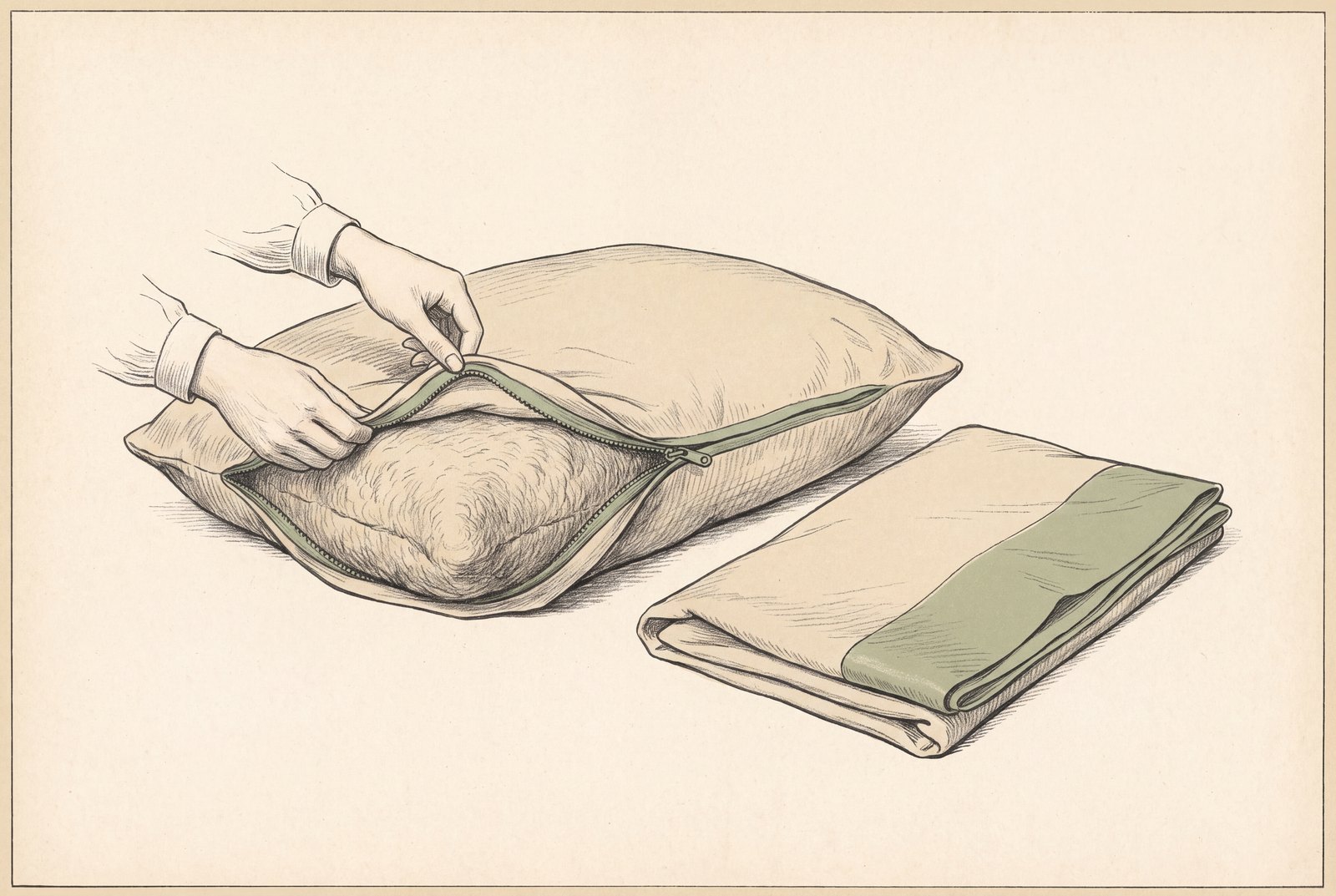
How you fix settling depends on how the pillow is built. A zippered pillow lets you add wool back. Sachi Organics says its zipper lets you adjust the pillow to your preferred sleep position and comfort level (Sachi Organics). You can't top up a sewn-shut batting pillow. Airing it in the sun between uses is the usual advice. Eartheasy lists its pillow as spot clean only, so the case and a cover take the washing.
Our judgement: if you buy a sewn pillow, pick the thickness you want after settling, not the one that feels right out of the box. If you sleep on your side and like a tall pillow, a zipper gives you the most room to correct the height later on. Our care page covers sunning, airing and cases.
Does wool help you sleep cooler?
Possibly. Lab studies found wool sleepwear helped some people fall asleep faster, but none we read tested a pillow on its own.
The best-known evidence comes from the University of Sydney. In a lab trial, the time it took people to fall asleep was significantly shortened when they slept in wool rather than cotton sleepwear (Dove Medical Press, 2016). A later study looked only at sleepwear and found adults fell asleep faster in wool than in polyester or cotton (Woolmark). Those benefits were most relevant to older and poorer sleepers. You may notice less if you already sleep well.
Keep two cautions in mind. Woolmark, which reports the second study, is the wool industry's own marketing body, so read its summary with that in mind. And both studies tested what people wore, not what they laid their heads on. None of the work we read put a wool pillow up against another pillow on its own.
Buy a wool pillow for how it feels and breathes, not for a promised sleep gain. Nothing we read suggests that organic certification changes how the fibre handles heat. Whether the wool is organic affects how the sheep were raised and how the pillow was processed. That difference is not one a sleeper can feel at night.
Is an organic wool pillow a good choice if you have dust mite allergies?
Not by default. Allergy groups advise dust-proof covers and hot washes, and many wool pillows are spot clean only, so the cover does the work.
Some seller pages claim dust mites do poorly in wool. None of the seller pages we read cited a clinical study of a wool pillow to back that up. You should treat it as a claim rather than a result.
Medical advice focuses on covers and washing instead. ACAAI recommends dust-proof covers on pillows and washing bedding in hot water of at least 130 degrees Fahrenheit (ACAAI). That advice does not depend on the fill, and it applies to wool, feather or synthetic pillows alike.
The conflict is a practical one. You can't wash a spot-clean pillow hot, and several wool pillows we read are spot clean only. If you have a mite allergy and still want wool, zip the pillow inside a dust-proof cover, then wash the cover and pillowcase hot. The wool itself never needs washing. The layers that meet your face get the hot wash your allergist is likely to ask for.
A zippered, dust-proof cover also protects the organic premium you paid, because it keeps skin oils and spills out of wool you cannot launder. If allergies shape your choice, talk to your allergist before you rely on any claim about the fill. The cover and the hot wash carry the allergy advice here, not the certificate.
What should you look for in an organic wool body pillow?
Check the wool weight, the length, and which part is organic. A heavier fill gives you a pillow that holds its shape between your knees.
| Seller | Wool weight stated | What the page calls organic | Zipper stated |
|---|---|---|---|
| Savvy Rest | About six or seven lb, by width | Cotton casing; "organic wool" in the title | Yes, fill is removable |
| The Futon Shop | Two to seven lb | Cotton sateen; fill called both "organic wool" and "natural wool" | Not recorded |
| Obasan | Not stated | Title says organic wool; fill is wool knops | Not recorded |
A body pillow holds several times the wool of a bed pillow, so any organic premium is multiplied too. Weight tells you how the pillow will behave: a heavy one holds its shape between your knees, and a light one folds when you hug it. If you want support for your hips, go heavy; if you want something to hug, go light.
Look for a zipper. Savvy Rest says you can remove the fill by unzipping the inner and outer casings (Savvy Rest). A pillow this long rarely feels right on its first fill. A zipper fixes that at home.
Then read the fill wording twice. The Futon Shop's page says each pillow is filled with organic wool, and a few lines away says it is made with certified organic cotton and filled with natural wool (The Futon Shop). Both phrases sit on the same page. When a page says both, ask the seller which one is true before you pay an organic price.
Common questions
Short answers to the questions people ask most about organic wool pillows, from washing and zippers to fit, firmness, and how they differ.
Is organic wool softer than regular wool?
Nothing we read says so. Organic certification covers how the sheep are raised and, under GOTS, how the finished product is processed. How soft a pillow feels depends more on whether the wool is layered batting or loose tufts.
Can you add wool to a pillow later?
Yes, provided the pillow zips open. Sachi Organics says its zipper lets you adjust the pillow to your sleep position and comfort level (Sachi Organics). A sewn-shut batting pillow stays at the height it settles to, so you would replace it instead.
Can you wash an organic wool pillow?
Usually not in a machine. Eartheasy's pillow is spot clean only, while the separate case is machine washable in cold water (Eartheasy). A zippered cover you can wash is the practical answer.
Does a wool pillow fit a standard US pillowcase?
Yes. Frankenmuth sells its standard wool pillow at the US standard size (Frankenmuth Woolen Mill), and Eartheasy's standard is slightly shorter (Eartheasy), so either one slips into a standard case with a little room to spare.
Which thickness suits people who sleep on their side?
Usually the middle or heavier fill, in our judgement, because the pillow has to fill the space between your ear and your shoulder. Allow for settling of about 30% when you choose. If unsure, pick a zippered pillow.
How is an organic wool pillow different from any wool pillow?
Only in the certificate. Weight, thickness and care are the same decisions either way. For the wider question, read Is a wool pillow worth it, and how do you choose one?
Sources
Here are the pages, papers and shops this wool guide draws on, each named beside the question it answers.
- Organic Bed & Baby (organicbedandbaby.com), drawn on in “Do organic wool pillows always contain organic wool?”; “How much wool goes into a standard pillow?”.
- Eartheasy (eartheasy.com), drawn on in “Key Takeaways”; “Do organic wool pillows always contain organic wool?”; “How much wool goes into a standard pillow?”; “Does a wool pillow flatten over time?”; “Common questions”.
- Frankenmuth Woolen Mill (wool-bedding.com), drawn on in “Key Takeaways”; “Do organic wool pillows always contain organic wool?”; “How much wool goes into a standard pillow?”; “Does a wool pillow flatten over time?”; “Common questions”.
- Specialty Fabrics Review (specialtyfabricsreview.com), drawn on in “Key Takeaways”; “What does "organic" mean on a wool pillow?”.
- OTA (ota.com), drawn on in “What does "organic" mean on a wool pillow?”.
- USDA AMS (ams.usda.gov), drawn on in “What does "organic" mean on a wool pillow?”.
- USDA AMS (ams.usda.gov), drawn on in “What does "organic" mean on a wool pillow?”.
- FTC (ftc.gov), drawn on in “How can you check an organic claim before you buy?”.
- My Organic Sleep (myorganicsleep.com), drawn on in “How can you check an organic claim before you buy?”; “Do organic wool pillows always contain organic wool?”.
- Sachi Organics (sachiorganics.com), drawn on in “Do organic wool pillows always contain organic wool?”; “Does a wool pillow flatten over time?”; “Common questions”.
- American Blossom Linens (americanblossomlinens.com), drawn on in “Do organic wool pillows always contain organic wool?”; “How much wool goes into a standard pillow?”.
- Dove Medical Press, 2016 (dovepress.com), drawn on in “Does wool help you sleep cooler?”.
- Woolmark (woolmark.com), drawn on in “Does wool help you sleep cooler?”.
- ACAAI (acaai.org), drawn on in “Is an organic wool pillow a good choice if you have dust mite allergies?”.
- Savvy Rest (savvyrest.com), drawn on in “What should you look for in an organic wool body pillow?”.
- The Futon Shop (thefutonshop.com), drawn on in “What should you look for in an organic wool body pillow?”.
- Obasan (obasan.com), drawn on in “What should you look for in an organic wool body pillow?”.