Is an organic wool and buckwheat pillow worth it for you?
Updated .
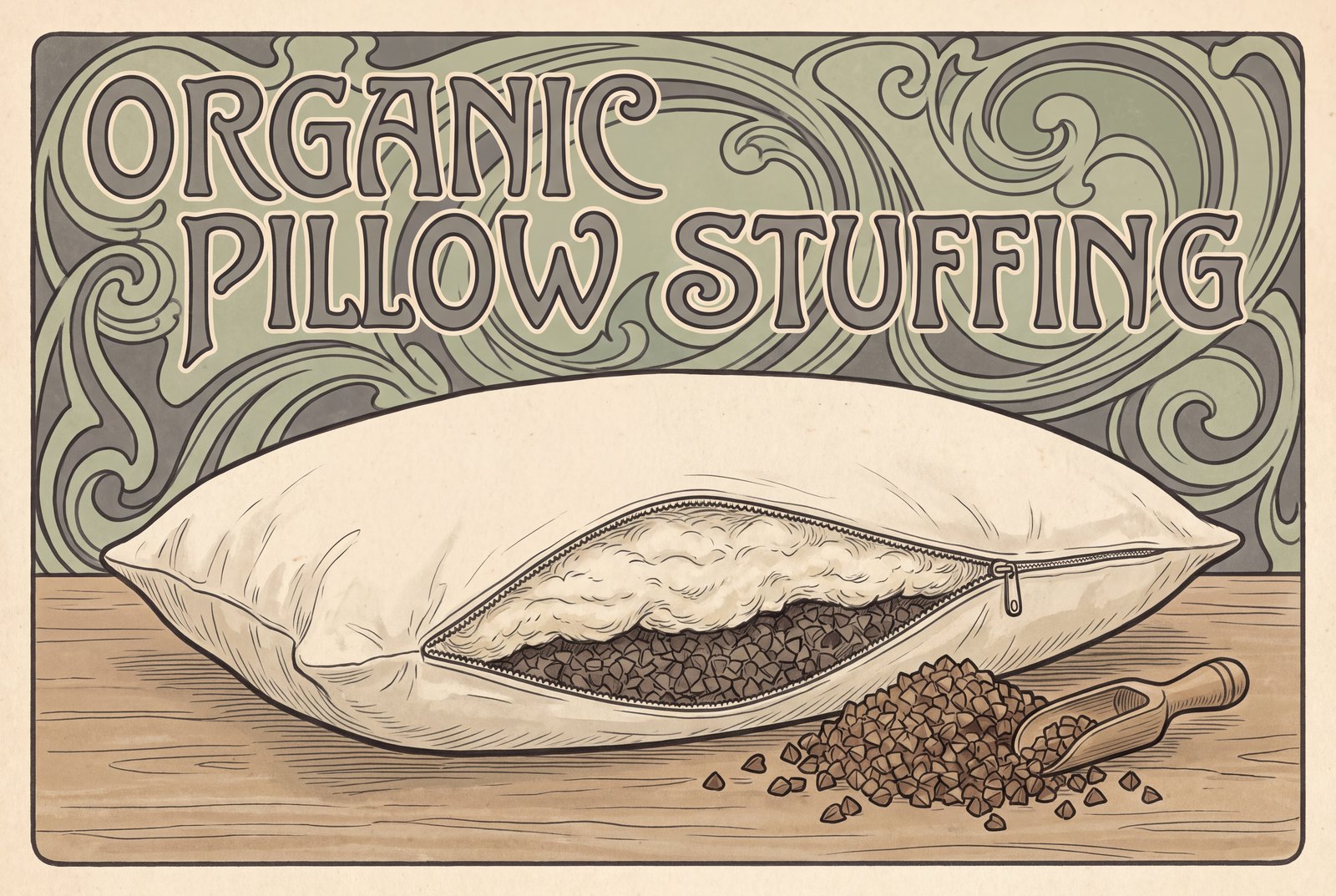
An organic wool and buckwheat pillow puts a soft wool layer over a core of buckwheat hulls. You get firm support you can shape yourself, with a quieter and gentler surface on top. There is little research behind it. The studies that exist are small but sound, and the organic labels cover less than most people assume. There is also one allergy risk to check before buying.
Short answer: It is worth it if you want firm, adjustable support and can live with a heavy pillow you cannot wash whole. The one head-to-head trial of buckwheat pillows we found had just 30 older adults, who reported less neck and shoulder pain after two weeks (Korean Journal of Health Promotion, 2019). The wool layer softens the surface and holds more moisture than other common textile fibers (Nature and Science of Sleep, 2019). Skip it if you have a buckwheat allergy.
This guide is for: people shopping for a two-fill pillow who want to know what the organic label covers, whether the support claims hold up, and how to set the height at home.
Key Takeaways
Three findings from the research, the labeling rules and our own count of seller pages, each with the figure that backs it up.
- The one direct trial of buckwheat pillows we found followed 30 older adults over two weeks. Treat neck-pain claims as an early signal (Korean Journal of Health Promotion).
- A GOTS "made with organic" label can mean as little as 70 percent certified organic fiber. Read the grade printed beside the logo (Fibre2Fashion).
- Of the 6 seller pages in our count, none named a certification standard for the pillow's own wool, and half did not call the wool organic at all.
On This Page
The eight questions this guide answers, in order, followed by short answers to common questions about weight, washing and price.
What is an organic wool and buckwheat pillow?
It is one pillow with two chambers: a firm core of buckwheat hulls and a soft layer of wool, each reachable through its own zipper.
Most sellers stack the layers, with wool on top and hulls below, and you pick the feel by choosing which face is up. The Futon Shop describes its version as a layer of wool fiber over a compartment of buckwheat hulls, with a dual-chamber design you can customize.
The hulls do most of the work. One retailer describes a Sachi Organics dual-chamber pillow as a generous foundation of moldable hulls with wool batting on top, in a case narrower than standard (Natural Linens). Check the dimensions before buying. A narrow pillow can slide around inside a standard pillowcase.
Weight follows the hulls. One hull seller says a 10-pound bag is enough to refill a standard buckwheat pillow (PineTales). A wool and buckwheat pillow replaces part of that with wool, so it weighs less than an all-hull pillow. It is still far heavier than a fiber pillow, and you will notice it every time you make the bed.
If wool batting is new to you, our page on wool fill explains how it is made and why it feels the way it does.
How does each layer change the way the pillow feels?
The hulls give firm support that holds its shape, and the wool softens the surface and muffles the rustle hulls make when you move.
Buckwheat hulls are the stiff, three-sided shells that milling strips off the grain. When you press into them they shift and then lock, so the pillow holds whatever shape you give it. That is the appeal. The downsides are a firm, grainy surface under your ear and a rustle every time you turn over.
The wool layer deals with both. It sits between your ear and the hulls, so in our judgement it cushions both the feel and the sound of the hulls. Wool is springy fiber, so it gives under your cheek and adds a little height without making the pillow much firmer.
Wool also helps you sleep cooler. It has the highest moisture regain of the common textile fibers, and it can take up and pass along large amounts of moisture (Nature and Science of Sleep, 2019). As the damp from your skin moves into the wool and away from you, the heat leaves with it. You feel a cooler surface under your cheek through the night.
| Buckwheat hull layer | Wool layer | |
|---|---|---|
| Main job | Support and height | Softness and quiet |
| Feel | Firm and grainy, holds a shape | Soft and springy, packs down with use |
| Sound | Rustles when you move | Makes no noise |
| Adjusting | Scoop hulls in or out | Tease the batting apart or add more |
| Cleaning | Keep dry and never wash | Air it out, since washing risks felting |
You can choose between the two every night. Sleep wool side up when you want a soft, quiet surface.
What does organic mean for the wool, the hulls and the cover?
Three parts can each carry an organic claim, under different rules: the hulls under USDA crop rules, and the wool and cotton under GOTS or USDA.
Each part answers to different rules. The hulls are a crop. Under USDA organic rules, a product sold as organic needs at least 95 percent certified organic content (USDA Agricultural Marketing Service). Wool comes under the livestock side of the same program, but the federal rules set no processing standards for finished textiles such as mattresses (Organic Trade Association). So a USDA seal on the hulls says nothing about the wool. Anyone who wants organic wool next to the face should look for a seal that names the wool itself.
GOTS, the Global Organic Textile Standard, grades finished textiles by how much of their fiber is certified organic (Fibre2Fashion).
| Wording on the page | What it tells you |
|---|---|
| USDA organic seal on the hulls | At least 95% certified organic content, verified by an accredited certifier |
| GOTS "organic" on the wool or cover | The top grade, at or above the 95% line |
| GOTS "made with organic materials" on the wool or cover | Between 70% and 95% of the fibers are certified organic |
| "Certified organic" with no standard named | Nothing you can check until the seller names the certifier |
| "Eco-wool" or "pure wool" | No organic claim at all |
Organic hulls are not always better hulls. One US seller says it buys uncertified hulls when that crop is higher quality, because crushed hulls lose spring and airflow (Hullo). Our guide on what makes a wool bed pillow organic covers the wool side in more depth.
Does a buckwheat and wool pillow help with neck pain?
Maybe. One small trial found less neck and shoulder pain on buckwheat than on latex, but no trial we found tested the wool and hull pair.
The best evidence is a single crossover trial. At a convalescent hospital in Korea, 30 older residents used a buckwheat pillow and a latex pillow in turn, with a break between them (Korean Journal of Health Promotion, 2019). On buckwheat, their scores for neck pain, shoulder pain and neck disability all fell. On latex, neck pain and disability fell, but the change in shoulder pain was not statistically significant. The authors concluded that buckwheat was the better of the two for neck and shoulder pain.
Read it with its limits in view. It was run at one site, with a small group of older adults, over a short period. The pillows were plain buckwheat with no wool top. No trial we found has tested a wool and buckwheat pillow against anything.
The trial does support the idea sellers build on: a fill you can shape so your neck stays level. In a two-fill pillow, that job belongs to the hulls. The wool only changes the surface you feel. So judge the pillow by whether you can set the hull height to suit your body.
If your neck pain is new, severe or getting worse, see a clinician. A pillow can make you more comfortable, but it cannot treat an injury.
Will a wool and buckwheat pillow keep my head cool?
Hulls leave gaps that let air move, and wool takes up vapor, though the wool sleep studies tested sleepwear and bedding only.
The two fills help with heat in different ways. Packed hulls leave gaps, so air can move through the core. A Polish team studying hull-filled mattresses built a rig to measure how air passes through such products (Polish buckwheat hull study, PMC). That work tested mattresses only, so treat it as a clue.
Wool helps by taking up the vapor your skin gives off. The sleep research on wool is stronger than most pillow research, but it tested clothing and bedding. An earlier study of healthy young adults found that they fell asleep sooner in wool sleepwear than in cotton, while the type of bedding made no difference (Nature and Science of Sleep, 2019). The same 2019 paper tested adults aged 50 to 70 in a warm room and found small but significant sleep benefits for wool over cotton and polyester sleepwear. The pillow was never the thing being tested. Keep that in mind.
In practice, if you sleep hot, turn the hull side up in summer and let the air move. Our guide to whether a wool pillow is worth it covers wool on its own.
Who should avoid a pillow filled with buckwheat hulls?
People allergic to buckwheat should skip it. Flour dust on poorly cleaned hulls has triggered asthma, and US doctors have reported pillow cases.
Buckwheat is a known food allergen, and a pillow keeps your face on it for hours. The hull itself carries little protein. Milling can leave flour dust behind, though, and people breathe that dust in. An allergist made this point when Korean researchers reported three children with night-time asthma linked to buckwheat pillows (HealthDay).
There are US cases too. An allergen reference describes an earlier report of a person who developed asthma and worse allergic rhinitis while using a buckwheat pillow. It also notes pillow users in Germany and the US who reported allergic symptoms (Thermo Fisher allergen encyclopedia).
Keep the risk in proportion. A review of buckwheat allergy research, which included studies on pillow allergy, estimated that 0.1 to 0.4 percent of the population is allergic in Japan, Korea and the parts of China where buckwheat is eaten (Plants, PMC).
If you or your child has a buckwheat allergy, choose an all-wool pillow. If you get a stuffy nose or a night cough after switching, stop using the pillow. Then tell your doctor.
What do seller pages say about the wool inside?
We counted six seller pages for wool and buckwheat pillows, and none of them named a certification standard for the pillow's own wool.
We read 8 seller product pages for wool and buckwheat pillows on September 26, 2026. Two of them could not be reopened when this guide was first checked, so the count below covers the other six. Two of those have since been taken down, and two are from sellers this guide leaves unnamed. We sorted each one into three buckets by how its product text described the wool. It counts wording and judges no pillow.
| Bucket | Pages | Count |
|---|---|---|
| Named a standard for the pillow's wool | None | 0 |
| Called the wool organic but named no standard | The Futon Shop, TFSleep, one other seller's page | 3 |
| Did not call the wool organic | Mattress Nation and Sachi Organics (both pages since taken down), one other seller's page | 3 |
The middle group is the one to watch, because organic without a named standard gives a buyer nothing to check. Two pages in that group, The Futon Shop and TFSleep, use the same wording.
A missing standard does not prove the wool is uncertified. It means you cannot check. Ask the seller for the certifier's name before you pay extra for the word organic. The last group is honest in its way, since "eco-wool" makes no organic claim. It just tells you less.
How do you set the height and care for the pillow?
Adjust the hulls first: remove a cup at a time until your neck sits level, then keep the hulls dry and wash only the pillowcase.
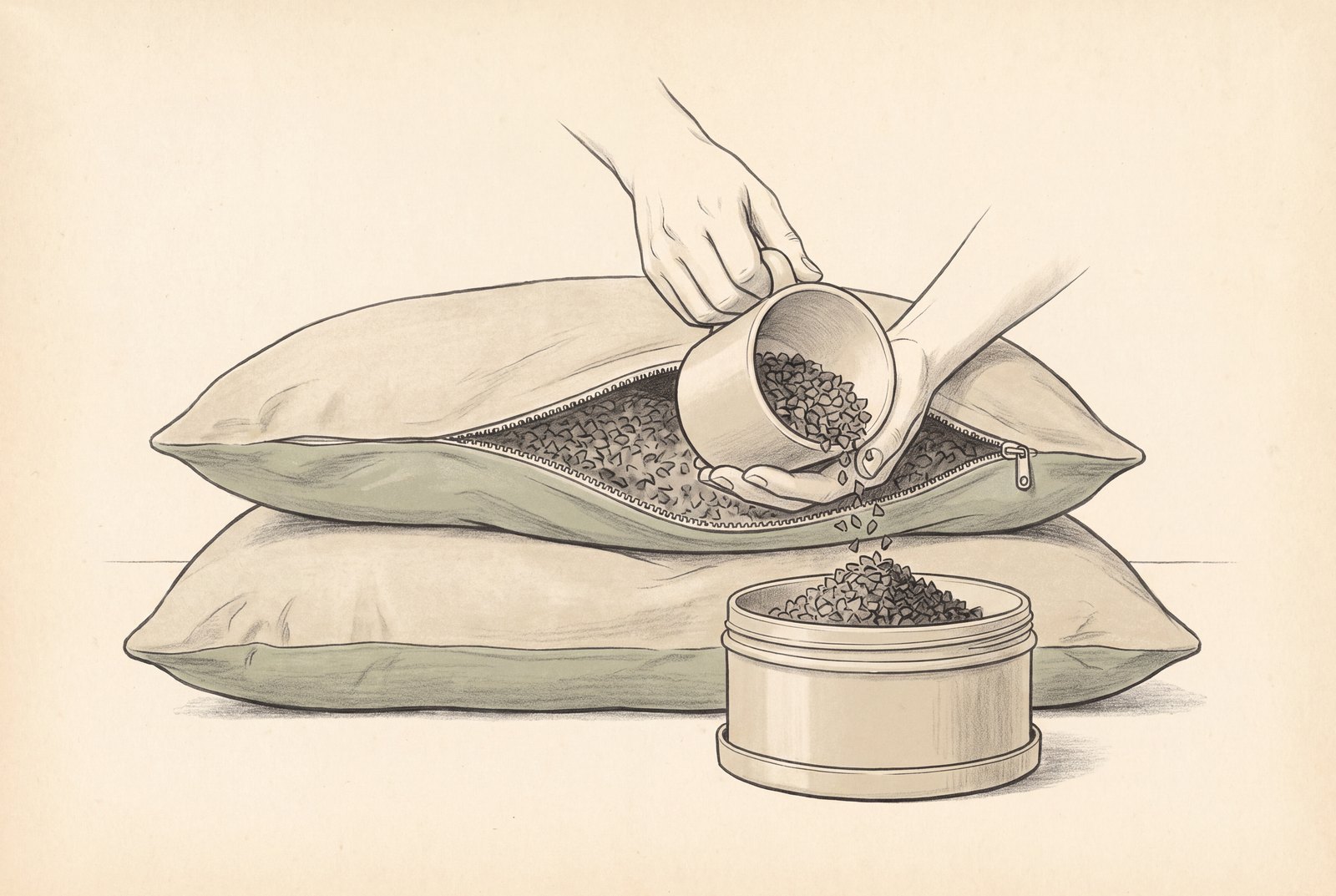
Set the height with the hulls first, since they carry your head. The Futon Shop tells buyers to unzip the chamber and add or remove hulls until the support feels right. Natural Linens, which sells a Sachi Organics pillow, says it gives 4 inches of height lying flat with the wool on top, and more when rotated a quarter turn onto its side. Take hulls out a cup at a time. Lie down after each change. Save the spare hulls in a dry, closed container so you can add them back later.
| If you | Start here (our judgement; no maker publishes it) |
|---|---|
| Sleep on your side | Keep most of the hulls and sleep wool side up to cushion your ear |
| Sleep on your back | Remove hulls until your chin sits level |
| Sleep on your stomach | Expect it to feel too tall and firm, so an all-wool pillow may suit you better |
| Sleep hot | Turn the hull side up on warm nights |
| Share a bed with someone who wakes easily | Keep the wool side up to quiet the rustle |
| Have a buckwheat allergy | Skip this pillow and choose an all-wool one |
Care is mostly about moisture. One hull seller warns that damp hulls can grow mold and break down (PineTales). Do not machine-wash the wool, because water and agitation felt it. Put a washable pillowcase over the whole pillow and wash that instead.
Common questions
Short answers to what people ask most about weight, washing, bugs, price and which face of a wool and buckwheat pillow to sleep on.
How heavy is an organic wool and buckwheat pillow?
It is heavier than most pillows you have owned. A standard all-hull pillow takes about a 10-pound bag of hulls (PineTales). A two-fill pillow replaces part of that with lighter wool.
Can you wash the whole pillow?
No. The hulls should stay dry, and wool felts when it is washed, so wash only a pillowcase or removable cover. Air the pillow out on a dry day now and then.
Do buckwheat hulls attract bugs?
Clean hulls give insects little to eat. Leftover bits of grain draw them, so one seller describes screening and heat-treating its hulls (PineTales).
How much does one cost?
Prices vary by size and seller. One Outside editor paid $90 for a wool-topped buckwheat pillow (Outside). Check the return policy before you buy, because a heavy hull pillow is costly to ship back.
Does the wool layer go flat?
Wool packs down with nightly use. On zippered models you can tease the batting apart or add more, and The Futon Shop says its dual-chamber design lets you customize the pillow.
Which side should face up?
Put the wool side up for softness and quiet, and the hull side up for firmness and airflow. You can switch with the seasons, hull side up when the bedroom is warm.
Sources
Here are the pages, papers and shops this wool guide draws on, each named beside the question it answers.
- Korean Journal of Health Promotion, 2019 (e-kjhp.org), drawn on in “Key Takeaways”; “Does a buckwheat and wool pillow help with neck pain?”.
- Nature and Science of Sleep, 2019 (dovepress.com), drawn on in “How does each layer change the way the pillow feels?”; “Will a wool and buckwheat pillow keep my head cool?”.
- Fibre2Fashion (fibre2fashion.com), drawn on in “Key Takeaways”; “What does organic mean for the wool, the hulls and the cover?”.
- The Futon Shop (thefutonshop.com), drawn on in “What is an organic wool and buckwheat pillow?”; “What do seller pages say about the wool inside?”; “How do you set the height and care for the pillow?”; “Common questions”.
- Natural Linens (naturallinens.com), drawn on in “What is an organic wool and buckwheat pillow?”; “How do you set the height and care for the pillow?”.
- PineTales (pinetales.com), drawn on in “What is an organic wool and buckwheat pillow?”; “How do you set the height and care for the pillow?”; “Common questions”.
- USDA Agricultural Marketing Service (ams.usda.gov), drawn on in “What does organic mean for the wool, the hulls and the cover?”.
- Organic Trade Association (ota.com), drawn on in “What does organic mean for the wool, the hulls and the cover?”.
- Hullo (hullopillow.com), drawn on in “What does organic mean for the wool, the hulls and the cover?”.
- Polish buckwheat hull study, PMC (pmc.ncbi.nlm.nih.gov), drawn on in “Will a wool and buckwheat pillow keep my head cool?”.
- HealthDay (healthday.com), drawn on in “Who should avoid a pillow filled with buckwheat hulls?”.
- Thermo Fisher allergen encyclopedia (thermofisher.com), drawn on in “Who should avoid a pillow filled with buckwheat hulls?”.
- Plants, PMC (pmc.ncbi.nlm.nih.gov), drawn on in “Who should avoid a pillow filled with buckwheat hulls?”.
- TFSleep (tfsleep.com), drawn on in “What do seller pages say about the wool inside?”.
- Outside (outsideonline.com), drawn on in “Common questions”.