Why does a wool pillow felt, and what handling prevents it?
Updated .
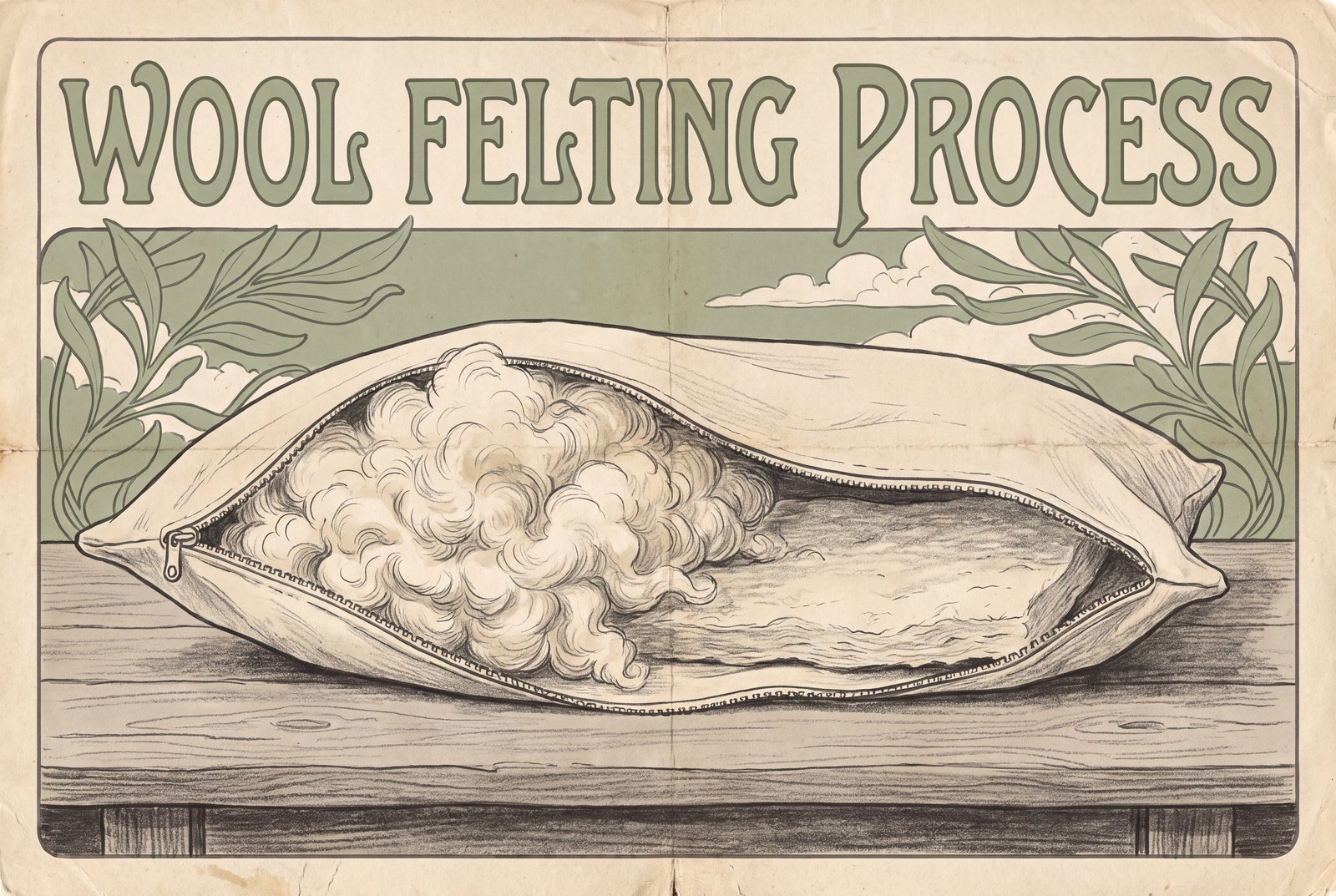
A wool pillow that has turned thin and hard has usually felted, and you can't undo felting. It needs water, warmth and movement at the same time, and a classic lab study found untreated wool felts fastest once wash water is well short of boiling. Normal sleep rarely brings all three together. Washing does.
Short answer: A wool pillow felts when its fill is wet, warm and moving all at once. Tiny scales cover each fiber and let it slide one way but not back. When you agitate the pillow, the fibers ratchet into a dense mat that won't pull apart again. Untreated wool reaches its top felting rate somewhere between 104 and 158°F (40 and 70°C) (Textile Research Journal study). Keep the fill dry, fluff it by hand, wash only the cover, and never wring, spin or tumble wet wool.
This guide is for: people who own a wool-filled bed pillow, or plan to buy one, and want the fill to stay springy.
Key Takeaways
Three facts carry most of this page: what starts felting, how warm is too warm, and what the sellers we read tell you to do.
- It takes 3 conditions at once: water, warmth and movement. Scales on each fiber let it move one way only. The fibers interlock and cannot return to their original positions, according to a shrink-resistance review in PMC. That means a wet pillow tumbling in a machine packs its fill into a mat for good.
- Untreated wool reaches its top felting rate at 104 to 158°F (40 to 70°C). That comes from a Textile Research Journal study of wool fabric in wash solutions. Cold water gives you the widest margin, and it costs you nothing in cleaning a pillow you rarely wash.
- Of 10 seller care pages we read, 4 say never wash the fill. Another 2 allow hand washing only, and 4 allow a gentle machine cycle. Those machine pages mostly describe wool treated to resist felting, so check which kind of wool you own first.
On This Page
Each entry below is a question from this page, in reading order, so you can jump to the one that matches the problem you have now.
What is felting, and why does wool do it when other fills don't?
Felting is wool fibers locking together for good. Their surface scales let them slide one way only, so each nudge packs them tighter.
Put a wool fiber under a microscope and you see overlapping scales, laid like roof shingles from root to tip. When wool meets mechanical action in the presence of moisture, the individual fibers start to move, and because of the surface scales they can move in only one direction (shrink-resistance review, PMC). The scale edge of one fiber locks into the gap between scales on another, like a ratchet. Each nudge moves a fiber forward. The scales stop it from sliding back.
That one-way movement is why felting is permanent: the fibers interlock and cannot return to where they started. A US patent on shrink resistance describes wet wool under repeated squeezing packing closer "until what was originally a comparatively soft structure becomes a hard mass of interlocking fibers" (US patent on shrink-resistant wool).
In your pillow, that hard mass is the whole problem. Height comes from crimp, the natural wave that holds fibers apart and traps air. Our guide on why crimp makes wool work in a pillow explains how that spring works. Felting closes those air gaps for good.
Plant fills such as cotton and kapok have no scale layer, so they can flatten or clump, but they don't felt this way. That's why wool comes with care rules that other natural fills skip. The rules all target the same three triggers, which the next section lays out.
Which conditions make a wool pillow felt?
Three things together: water, warmth and movement. Take away any one and felting mostly stops, which is why fluffing a dry pillow is safe.
The Woolmark Company, the wool industry's standards body, describes the sequence. When exposed to heat and moisture the scales lift, and mechanical agitation then locks them onto the scales of other fibers in a ratchet-like mechanism that is irreversible (Woolmark). Each condition does a different job. Remove one and you break the chain.
| Condition | What it does to the fiber | Where your pillow meets it |
|---|---|---|
| Water | Lets the scales lift and catch | A wash, a soaking spill, a damp closet |
| Warmth | Speeds the whole process up | Warm wash water, a hot dryer, a radiator |
| Movement | Pushes fibers past each other so scales lock | Agitation, spinning, wringing, tumbling |
| Dry pressure alone | Packs fibers flatter, but the packing pulls back out | Your head, night after night |
Pillow makers name the same triggers in their own words. One UK maker says felting happens when wool fibers are twisted, agitated, or exposed to sudden temperature changes (Floks). An Idaho maker goes further and says agitation alone causes felting (The Woolshire).
The working rule follows from the mechanism: whenever the fill is wet, keep it cool and keep it still. When the fill is dry, you can fluff it hard without that worry. Most damage happens in the hour after a spill or a wash, when people reach for the machine out of habit.
How hot is too hot for wool fill?
Lab felting of untreated wool speeds up as water warms and tops out well below boiling. Cold water is the safer choice for any wash.
The clearest figures come from a study in the Textile Research Journal. The rate of felting of untreated wool fabric rose with the temperature of the solution until it hit a maximum between 104 and 158°F (40 and 70°C), then stayed constant as the water got hotter (Textile Research Journal study). The exact peak depended on the solution's pH and on the action of the machine.
Two points follow for you. Warm water is already close to the worst case, because the top rate arrives well before the water gets hot. You don't need scalding water to ruin a pillow.
The second point matters as much. Temperature is only one dial. Chemistry and machine action shift the peak, so no single temperature counts as safe for untreated wool. Cold water is the sensible default because it keeps you furthest from the peak whatever else is going on.
Temperature swings count too. One maker tells you to rinse in warm water if you washed in warm, and in cold if you washed in cold, because sudden shifts can shock the fibers (Floks).
A dryer is where heat catches people out. A hot drum supplies warmth and movement at once, and damp fill supplies the water. Cold water, no dryer heat, and the same temperature from wash to rinse keep you furthest from the felting peak.
Does a wool pillow felt just from being slept on?
Slowly, and mostly as packing rather than felting. Your head adds pressure and night moisture, so fibers settle and need regular fluffing.
Each night your head presses the fill down while your skin and breath add a little moisture. Our guide on how much moisture wool holds at night covers that side. Some settling is expected. One retailer's listing says the pillows may settle up to 15% until they conform to the weight of your head (Natural Linens).
That settling is packing, not felting. A retailer's care guide says wool tamps down with use but springs right up again when pulled apart (The Clean Bedroom). You can tell the two apart by hand: a tuft of packed wool loosens when you pull it gently between your fingers, while felted wool holds together as a pad. That hand test is our own rule of thumb.
Daily fluffing keeps packing in check. One maker advises hand-fluffing daily to maintain height (The Woolshire product page). If your pillow has a zipper, open it. Woolroom suggests opening the pillow and teasing the loose fibers apart by pulling in opposite directions (Woolroom).
Slow felting can creep in where a pillow stays damp and gets pressed every night. Think of a pillow soaked by sweat and never aired. Give it a dry spell between uses and you remove the water that felting needs.
What do wool pillow sellers tell you about washing?
They disagree. Of ten care pages we read, four say never wash the fill, two allow hand washing only, and four allow a gentle machine cycle.
We read 10 sellers' and retailers' published care pages for wool-filled pillows on September 27, 2026, and sorted each by what it says about washing the wool fill itself. We washed, weighed and tested no pillows; the table records only what each page says about the fill.
| What the page says about the fill | Pages | Which pages |
|---|---|---|
| Never wash it; spot clean or air only | 4 | Holy Lamb Organics, Floks, The Clean Bedroom, Avocado toddler pillow |
| Hand wash only, never a machine | 2 | Shepherd's Dream, The Woolshire |
| A gentle machine cycle is allowed | 4 | Sleep & Beyond, Down Under Bedding, Lova, Woolroom |
The "never" pages are blunt. Holy Lamb Organics says spot clean only, and Avocado says its latex-and-wool fill is not machine-washable and will be damaged by submersion, agitation and heat.
The machine bucket still asks for a light touch. Sleep & Beyond allows cold water on a wool or delicate cycle without agitation, with wool detergent and no spin. Its washable wool gets a "Biowash" treatment so the fibers will not shrink like regular wool (Allergy Store listing). Down Under says many of its items, including its washable wool pillow, are made to be machine washable.
The split mostly follows the wool: untreated fill gets "never" or "by hand," and treated fill gets a gentle machine. Find out which kind you own before you follow any single page.
Which everyday handling carries the most felting risk?
Anything that moves wet wool. A warm machine wash with a spin is the worst case; brisk fluffing of a dry pillow is close to no risk.
This ranking is our judgement, based on how much water, warmth and movement each kind of handling combines. No maker publishes it, and we didn't test it.
| Handling | Felting risk (our judgement) | Why |
|---|---|---|
| Machine wash, warm, with spin | Highest | All three conditions at full strength |
| Tumble drying damp fill | High | Warmth and movement while the wool is wet |
| Wringing or twisting after a hand wash | High | Strong movement of wet fibers |
| Hand wash in cool water, pressing only | Moderate | Water present, movement kept small |
| Tumbling a fully dry pillow, no heat | Low, but disputed | Movement without water |
| Airing a dry pillow in sun | Very low for felting | No water or agitation; yellowing is a separate issue |
| Hand fluffing a dry pillow | Very low | Movement only |
Wringing ranks high for a reason makers spell out. Shepherd's Dream warns against wringing because the agitation can make wool clusters felt together (Shepherd's Dream).
Sellers argue about one row: the dryer. Woolroom calls the dryer on an air-dry or low-heat setting, with a couple of dryer balls, the easiest way to re-fluff (Woolroom). The Woolshire says never tumble dry, even on no-heat, because agitation alone causes felting (The Woolshire).
If you use a dryer, use it only on a pillow that is dry all the way through, with no heat, for a short run. Hand fluffing does the same job with no argument attached.
How do you clean a wool pillow without felting it?
Clean the cover, not the wool. Air the fill when dry, spot clean stains, and if you must wash, press in cool water and never wring or spin.
Most cleaning never needs to reach the wool. Put a zippered protector over your pillow and wash that instead. Holy Lamb says its cotton zipper cases can be machine washed in cold water and hung dry to prevent shrinkage (Holy Lamb care page).
To freshen the fill, air it. Shepherd's Dream suggests taking pillows out of their cases once each season and putting them in the sun to deodorize and refresh them (Shepherd's Dream). Keep those sessions short, and only sun a dry pillow. A review of wool photoyellowing lists the presence of moisture among the factors that affect how fast wool yellows (photoyellowing review).
For a stain, spot clean the cover with a damp cloth and let it dry fully. If a spill soaks through and you have to wash the fill:
- Use cool water, and keep the wash and the rinse the same temperature.
- Move the water, not the wool. Woolroom advises moving only the water to spread the soap.
- Press the excess water out, and never twist or squeeze (Floks).
- Plan for 24 to 48 hours of flat drying, since a pillow put back together while still damp inside will mildew (The Woolshire).
Fluff by hand while it dries, and wait until the center has lost its cool, damp feel before it goes back in its case.
Is washable wool fill a different material?
Same fiber, altered surface. Washable wool has its scales smoothed or coated so they cannot ratchet, which is why its label can say machine wash.
It's still wool, with its surface changed. Woolmark defines machine washable wool as wool treated or processed so it can go through a domestic washing machine without excessive shrinkage, felting or distortion (Woolmark). The treatments work by removing or smoothing the scales, by reducing friction between fibers, or by combining both.
Treated doesn't mean felt-proof. Woolmark's specification for knitted blankets allows a maximum shrinkage of 5%, with "acceptable" meaning a minimal level of felting after washing (Woolmark specification). Its wash test calls for a machine with a gentle wool cycle. Even washable fill expects a soft touch.
Untreated wool keeps its natural scale surface, which is why it felts and why many of its makers advise against washing it. Some choose this on purpose. Holy Lamb's care page links to an explainer called "Why Washable Wool Isn't For Us" (Holy Lamb care page).
If organic status is part of your choice, our guide on what makes a wool bed pillow organic covers it. Before you wash anything, check whether your fill is sold as washable. Your care instructions should say so.
Common questions
Short answers to the questions people ask once the pillow is already home, from rescuing a felted one to drying it after a spill.
Can a felted wool pillow be fixed?
The felted part can't be fixed. Felting shrinkage is irreversible; once it occurs, the original size cannot be recovered (shrink-resistance review, PMC). You can tease out packed fill and top up with fresh wool. If your pillow opens and its fill is built from layers of carded batting, you can lift a hardened outer layer away and replace it with fresh batting.
Is it safe to put a wool pillow in the dryer to fluff it?
Sellers disagree. Our view is to use a dryer only when the pillow is dry all the way through, with no heat, for a short run. Hand fluffing gets you most of the height back with no risk.
How long does a washed wool pillow take to dry?
Expect a day or two. The Woolshire says to plan for a day or two of flat drying (The Woolshire). Turn and fluff it often, and check the center before you use it.
Does sunlight damage wool fill?
Long exposure can. Sunlight tends to yellow undyed wool and can reduce its strength (US patent on wool photostability). Short airing of a dry pillow is fine. Never put a wet one in the sun.
Why does my wool pillow feel lumpy?
It's usually packing. Sleep & Beyond warns that frequent washing can make wool batting clump inside the cover (Sleep & Beyond). Pull the clumps apart. If they won't loosen, they have felted.
Should I wash the cover in hot water?
No. Holy Lamb says separate cases can be machine washed in cold water and line dried or tumbled on low (Holy Lamb Organics). Cold water also protects any wool quilted into the cover.
Sources
Here are the pages, papers and shops this wool guide draws on, each named beside the question it answers.
- Textile Research Journal study (doi.org), drawn on in “Key Takeaways”; “How hot is too hot for wool fill?”.
- shrink-resistance review in PMC (pmc.ncbi.nlm.nih.gov), drawn on in “Key Takeaways”; “What is felting, and why does wool do it when other fills don't?”; “Common questions”.
- US patent on shrink-resistant wool (image-ppubs.uspto.gov), drawn on in “What is felting, and why does wool do it when other fills don't?”.
- Woolmark (woolmark.com), drawn on in “Which conditions make a wool pillow felt?”; “Is washable wool fill a different material?”.
- Floks (floks.co.uk), drawn on in “Which conditions make a wool pillow felt?”; “How hot is too hot for wool fill?”; “What do wool pillow sellers tell you about washing?”; “How do you clean a wool pillow without felting it?”.
- The Woolshire (thewoolshire.com), drawn on in “Which conditions make a wool pillow felt?”; “What do wool pillow sellers tell you about washing?”; “Which everyday handling carries the most felting risk?”; “How do you clean a wool pillow without felting it?”; “Common questions”.
- Natural Linens (naturallinens.com), drawn on in “Does a wool pillow felt just from being slept on?”.
- The Clean Bedroom (thecleanbedroom.com), drawn on in “Does a wool pillow felt just from being slept on?”; “What do wool pillow sellers tell you about washing?”.
- The Woolshire product page (thewoolshire.com), drawn on in “Does a wool pillow felt just from being slept on?”.
- Woolroom (thewoolroom.com), drawn on in “Does a wool pillow felt just from being slept on?”; “What do wool pillow sellers tell you about washing?”; “Which everyday handling carries the most felting risk?”.
- Holy Lamb Organics (holylamborganics.com), drawn on in “What do wool pillow sellers tell you about washing?”; “Common questions”.
- Avocado toddler pillow (help.avocadogreenmattress.com), drawn on in “What do wool pillow sellers tell you about washing?”.
- Shepherd's Dream (shepherdsdream.com), drawn on in “What do wool pillow sellers tell you about washing?”; “Which everyday handling carries the most felting risk?”; “How do you clean a wool pillow without felting it?”.
- Sleep & Beyond (sleepandbeyond.com), drawn on in “What do wool pillow sellers tell you about washing?”; “Common questions”.
- Down Under Bedding (downunderbedding.com), drawn on in “What do wool pillow sellers tell you about washing?”.
- Lova (lovayatak.com), drawn on in “What do wool pillow sellers tell you about washing?”.
- Allergy Store listing (allergystore.com), drawn on in “What do wool pillow sellers tell you about washing?”.
- Holy Lamb care page (holylamborganics.com), drawn on in “How do you clean a wool pillow without felting it?”; “Is washable wool fill a different material?”.
- photoyellowing review (researchgate.net), drawn on in “How do you clean a wool pillow without felting it?”.
- Woolmark specification (woolmark.com), drawn on in “Is washable wool fill a different material?”.
- US patent on wool photostability (image-ppubs.uspto.gov), drawn on in “Common questions”.