What is the difference between wool batting, wool balls, and shredded wool in a pillow?
Updated .
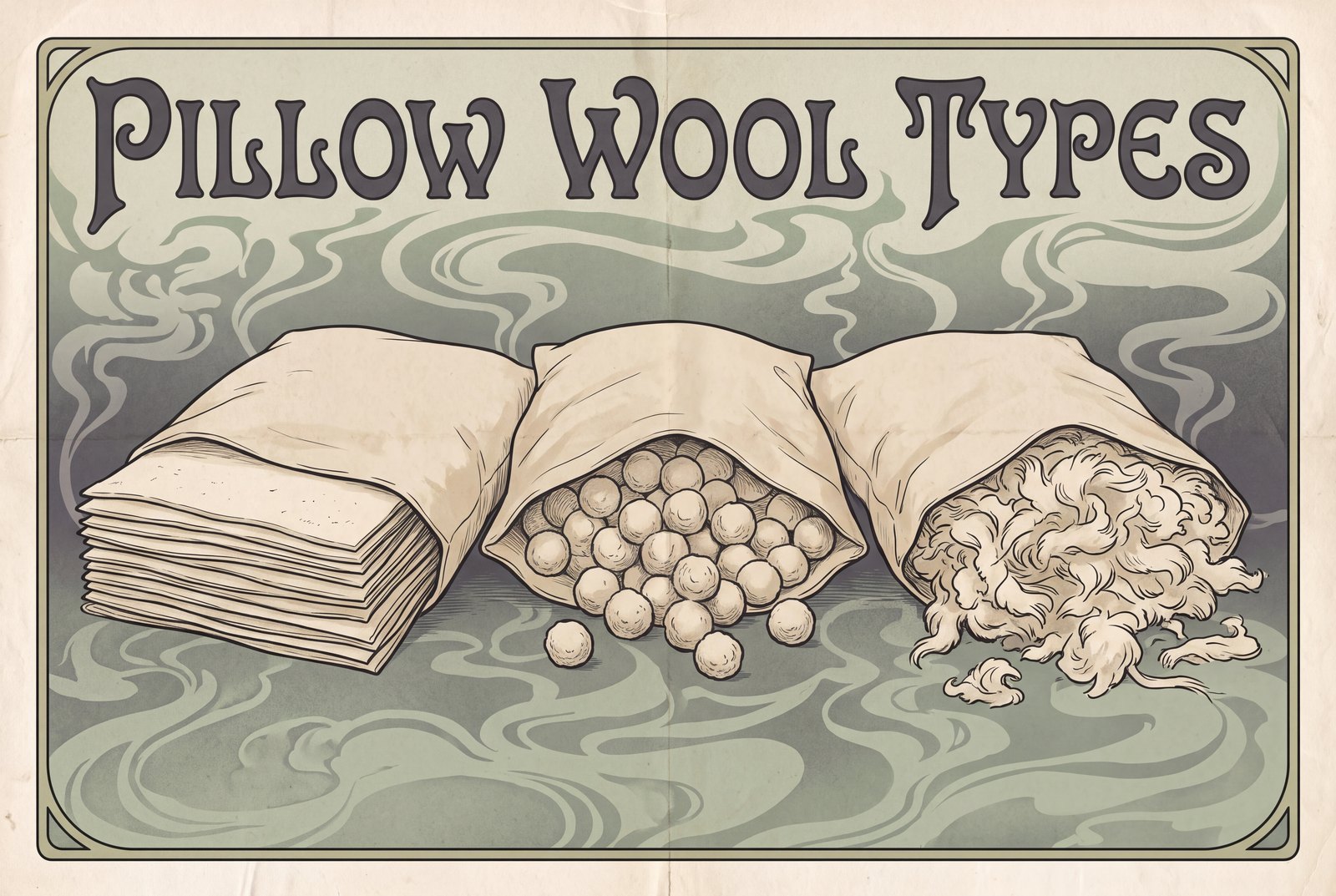
Three wool pillows can hold one kind of fiber and still behave like three different objects. One maker says pillows made with wool layers may settle 15-30% within the first few months of regular use (Holy Lamb Organics). Another fills each standard pillow with 30 ounces of wool in a zippered case you can open (American Blossom Linens). How much wool is inside matters. The shape it has been made into matters just as much for how your pillow feels by month six.
Short answer: Wool batting is carded wool laid down in layers and built into a pillow with a set shape. It starts tall, then packs down. Sellers warn of 15-30% settling (Holy Lamb Organics) or 30-40% compression (Shepherd's Dream) early on. Wool balls are small clusters in a zippered case, so you set the height yourself. "Shredded" wool is loose tufts of fiber. It is soft and easy to adjust, but it clumps more easily than the other two. Choose by how much reshaping you want.
This guide is for: people choosing a wool pillow who keep seeing the words batting, bolus and shredded on product pages and want to know what each one means at night.
Key Takeaways
Each of these three points rests on a figure you can check yourself, either on a seller's own page or in our count of seller pages.
- Batting pillows lose height by design. Sellers state 15-30% settling within the first few months (Holy Lamb Organics) or 30-40% compression within the first 6 months (Shepherd's Dream). Airing brings some height back.
- Ball and loose fills are adjustable by the ounce. Extra puffs come in 3- and 6-oz bags (Natural Linens), and extra bolus is sold in 8-ounce increments (American Blossom Linens). That lets you set the height a little at a time.
- Only 4 of the 12 seller pages we read gave both the fill form and a fill weight. Five named the form without a weight, and three named neither. You will often have to ask the seller for the weight yourself.
On This Page
Each entry below is a question this guide answers, in the order it answers them, so you can jump straight to the one you came for.
What are wool batting, wool balls, and shredded wool?
Wool batting, wool balls and loose wool are one fiber made three ways: layered carded batting, small round clusters and loose tufts of fiber.
Batting starts at the carding machine, which combs wool into thin, airy layers. Cuddle Ewe cleans its wool with biodegradable soap and then combs it gently into batting on a carding machine (Cuddle Ewe). Shepherd's Dream fills its sleep pillows with wool batting inside an organic cotton sateen case (Shepherd's Dream). Those layers are stacked to build the pillow. Its shape is fixed once the case is sewn around them.
Wool balls go by many names. You will see bolus, knop, puffs, clusters and "wooly down," and all of them mean small rounded balls of wool. Cuddle Ewe calls its small clusters knop. Holy Lamb Organics puts tiny puffs of wool in a zippered case of organic cotton sateen (Holy Lamb Organics). The balls move freely inside.
"Shredded wool" is the shopper's word, not the sellers' word. Pages selling loose fill rarely name a form at all. Woolino describes its pillow as filled with pure new wool and lets you remove the extra filling (Woolino). In our reading, "shredded" belongs mostly to latex and foam pillows. Savvy Rest, for example, sells a pillow of natural shredded latex in an organic cotton casing (Savvy Rest). In this guide, "shredded" means loose wool fiber that has not been formed into balls.
Why does one wool fiber behave differently in each form?
Wool fibers grip each other in one direction, so how tightly they start out packed decides whether a pillow springs back, mats, or clumps.
Every wool fiber is covered in tiny scales. The scales let it slide more easily one way than the other. In a mass of wool, fibers move preferentially in one direction and keep tangling with their neighbors (Textile Study Center). Press, rub and dampen a pile of fiber, and it tangles tighter.
A springy fill is what keeps your head up through the night. That spring comes from the shape of each fiber. Wool's compressibility is measured by pressing clean fiber in a cylinder under a standard weight. The volume left afterward is called its bulk. One physics model found that bulk depends on fiber diameter and fiber curvature only through their product (Physics Letters A, via OSTI). Curvature here means crimp, which our guide on why crimp makes wool work in a pillow covers. Diameter is the micron figure explained in how to read micron, grade, and staple. When a spec lists micron and crimp, you get a hint of whether the pillow will spring back under your head each time you turn over, or leave your neck sinking lower by morning.
The form decides how that spring gets used up. Batting is fiber laid in layers, so the layers resist your head together and pack down together. Balls are tangled before they reach you. They roll past each other and reshape. Loose tufts have free fiber ends that can catch on each other. One Idaho mill says carding its wool into flat sheets keeps its pillows from clumping the way loose-fill wool does (The Woolshire).
How much wool goes into a standard pillow of each type?
More wool lifts your head higher. A standard case holds one and a half to under three pounds. Compare within one form to keep your neck level.
A standard pillow in the United States measures 20 by 26 inches. Four of the seller pages we read state how much wool goes in. The figures spread wider than expected.
| Seller page | Fill form | Case size stated | Wool weight stated |
|---|---|---|---|
| Frankenmuth Woolen Mill | Batting | 20 x 26 in | 1.6 lb (about 26 oz) |
| Holy Lamb Organics, retailer listing | Batting | 20 x 25 in | 35, 39 or 43 oz by thickness |
| American Blossom Linens | Bolus (balls) | Standard | 30 oz |
| Cuddle Ewe | Knop (clusters) | 25 x 18 in | 2 lb |
Weight tells you the most within one maker's range. Holy Lamb's three standard weights line up with its Light, Perfect and Extra Thick versions. More wool gives you a thicker pillow. Note that its standard case is an inch shorter than the usual US size.
Comparing across forms is where weight stops being useful. We would expect balls to hold air in the gaps between them. Batting holds its air inside the layers. A given number of ounces can therefore sit at different heights. Compare fill weights only between pillows of one form. When a page gives a weight, ask which form it describes before you compare two prices. That one question keeps you from paying for height your head will never feel.
How much does each type flatten, and does that mean it is worn out?
Batting pillows are sold expecting a large early drop in height, and that drop is packing, not broken fiber, so it does not mean the pillow failed.
Batting sellers state the drop in writing. Holy Lamb says pillows made with wool layers may settle 15-30% within the first few months of regular use (Holy Lamb Organics). Shepherd's Dream says its wool fill will compress 30% to 40% within the first six months of regular use (Shepherd's Dream). One retailer puts it plainly: the pillow arrives very fluffy and will settle over time with the weight and heat of your head (Eartheasy).
That lost height comes from packing. Shepherd's Dream suggests airing the pillow on a sunny day, after which it will do some decompressing. A flatter pillow has packed fibers, and fresh air brings some of the height back. Plan on airing it every so often.
For cluster pillows, one retailer claims its wooly down pillow won't compress as much as batting pillows tend to (Pillows.com). None of the pages we read gave a figure for that.
The table below is our own judgement, drawn from the seller pages cited here. No maker publishes this comparison.
| Form | Early settling | Restoring height | Main risk |
|---|---|---|---|
| Batting | Largest; sellers state it | Airing helps; you can only add wool if it has a zipper | Sits lower than the product photo |
| Balls | Less, by retailer claim | Unzip, separate, add fill | Balls drift toward the edges |
| Loose tufts | No page we read states it | Pull apart by hand, add fill | Lumps where fibers tangle |
Which type can you adjust, and which is fixed?
Balls and loose fill almost always come in a zippered case you can open, while batting is often sewn shut around its layers.
Ball pillows are made to be adjusted. American Blossom says you can remove wool if the pillow is too full, or add it if it is not full enough (American Blossom Linens). With Holy Lamb's wooly down, you add or remove puffs until the pillow feels right (Natural Linens). Buy the smallest refill bag first.
Loose fill adjusts too, starting from the other end. Woolino lets you remove the extra wool filling to set the thickness you want (Woolino). Keep whatever you remove. American Blossom suggests storing unused stuffing in a zip-top plastic bag, so you can put it back later if the pillow softens.
Batting is mostly fixed. The Woolshire sews its cover shut for durability rather than fitting a zipper (The Woolshire). Holy Lamb offers choice by building three thicknesses instead: Light for stomach sleepers, Perfect for side and back sleepers, and Extra Thick for people who want a fuller pillow (Holy Lamb Organics).
There are exceptions. Herd Supply's pillow holds wool filling and batting behind a zipper, so a batting pillow can be adjustable (Herd Supply). Check for a zipper before you assume a batting pillow can be changed, and ask whether the seller sells extra batting at all.
How do you clean each type without felting it?
Water, heat and rubbing together are what felt wool, so the safe routine is to air and sun the fill and wash only the cotton case it sits in.
Wet, warm, rubbed wool felts. Every care rule below exists to stop that. Wool fibers creep in one direction and tangle with the rest, and the shrinkage that follows cannot be undone (Textile Study Center). A washing machine supplies water, warmth and rubbing all at once.
Batting is the least forgiving. It is rarely sold in a case you can open, so the whole pillow would have to go in the water. Frankenmuth recommends sunning its pillow outside and says spot clean only (Frankenmuth Woolen Mill). Shepherd's Dream suggests airing its batting pillows on a sunny day (Shepherd's Dream). Treat a batting pillow as something you air, not something you wash.
Balls and loose fill give you more options because you can empty the case. Holy Lamb says you can refresh wooly down by separating the puffs. The puffs themselves cannot be washed. The case can, once it is empty (Natural Linens). Cuddle Ewe describes washing its clusters in a basin of tepid water with a natural wool wash, then drying them in direct sunlight (Cuddle Ewe). If you try that, handle the wool gently and never wring or scrub it, because rubbing is what locks the scales together.
Does organic certification differ between the three types?
No. The organic standard certifies the finished pillow and every processing step, not the shape, so batting, balls and loose fill all qualify.
In the United States, the USDA says textiles that meet the Global Organic Textile Standard (GOTS) may be sold as organic (USDA Agricultural Marketing Service). GOTS looks at the whole supply chain, from farm to finished product. Its certificate belongs to the finished pillow. That USDA page also sets a limit. Unless the finished product is certified to USDA organic rules, its label may not call it USDA organic.
Nothing in those rules depends on whether the wool ends up as sheets or balls. One maker sells both forms with an organic claim. Holy Lamb sells a certified organic pillow built from layers of wool batting (Holy Lamb Organics), and describes the puffs in its wooly down pillow as organic wool (Holy Lamb Organics). The shape of the fill never came into it.
Check the label grade, and whether the claim covers the whole pillow or only the cover. Frankenmuth, for one, describes its covering as organic cotton and its wool by where it comes from. A page like that tells you about the fabric, not about the pillow as a whole. Look for the certificate on the finished pillow, not on the fabric around it. Our guide on what makes a wool bed pillow organic covers the paperwork in more depth.
What do wool pillow product pages tell you about the fill?
Most pages we read name the form of the wool, only a third give its weight, and a quarter never say what shape the wool inside takes.
We read 12 seller pages for wool bed pillows on September 27, 2026. We found them by searching for batting, ball and loose wool fill, then sorted each page by what it states about the fill inside. Every entry below rests on the words printed on those pages. We did not handle or test any pillow.
| Bucket | Pages | Which pages |
|---|---|---|
| Names the fill form and states a fill weight | 4 | Frankenmuth, Holy Lamb certified organic pillow, American Blossom Linens, Cuddle Ewe |
| Names the fill form but gives no weight for the pillow | 5 | Shepherd's Dream sleep pillow, Holy Lamb wooly down, The Woolshire, Herd Supply, Woolroom |
| Names neither the form nor a weight | 3 | Home of Wool (page since taken down), Woolino, Turmerry |
The last row is thin on detail. Home of Wool describes pure wool filling, Woolino pure new wool, and Turmerry crimped wool. None of the three says whether that wool is batting, balls or tufts. One more count stood out: no page in the set used "shredded" for its own wool.
For you, the gap is the weight. Ask for the fill weight and the expected settling before you buy whenever a page leaves either one out.
Which wool fill type should you choose for how you sleep?
Pick batting if you want a fixed, firm shape, balls if you want to tune height yourself, and loose fill only if you will fluff it often.
Start with how much adjusting you are willing to do. American Blossom pitches its bolus pillow at anyone who sleeps in multiple positions, which suits a fill you can push around. Holy Lamb says wool puffs have more substance than down, so they can take a shape and hold it. Batting suits people who want to settle on a shape once and then leave it alone.
The table below is our judgement, based on the pages cited in this guide. It ranks forms of fill, not products.
| If you... | Lean toward | Why, in our judgement |
|---|---|---|
| Want a firm shape and never want to unzip anything | Batting | It holds one shape, though it will sit lower after the first months |
| Change position through the night | Balls | You can push fill toward your neck or away from it |
| Sleep on your stomach and want a low pillow | Light batting, or a ball pillow filled low | Both start low or can be made low |
| Want a squashable, down-like feel | Loose tufts | Free fibers give easily, but need regular fluffing |
| Want one design for a whole household | Balls | Each person can set their own height |
If you choose batting, buy for the height the pillow will have after it settles, not the height it arrives at. With balls or loose fill, buy close to the height you want. Then fine-tune it later.
Common questions
Short answers to the questions people ask most once they have a wool pillow on the bed, drawn from the sections above and their sources.
Is wool bolus the same thing as wool balls?
Yes. Bolus, knop, puffs, clusters and wooly down all name small balls of wool. Cuddle Ewe, for one, calls its small clusters of wool knop (Cuddle Ewe).
Can you put a wool pillow in the washing machine?
Not the batting. Frankenmuth says its batting pillow is spot clean only (Frankenmuth Woolen Mill). With ball or loose fill, empty the case first and wash only the cotton case.
Why did my new batting pillow get flatter so fast?
Sellers expect it. Shepherd's Dream says its wool fill will compress 30% to 40% in the first six months (Shepherd's Dream). Airing it on a sunny day helps it recover some height.
Will loose wool fill turn lumpy?
It can. One Idaho mill says its layered sheets avoid the clumping seen in loose-fill wool. If clumps form, Cuddle Ewe says to empty the case and break the larger clumps apart by hand (Cuddle Ewe).
How much extra fill should you buy?
Start with the smallest bag on offer. Holy Lamb sells extra puffs in 3- and 6-oz bags (Natural Linens), and adding a little at a time lets you work up to the right height.
Does a heavier wool pillow mean a firmer one?
Within one maker's range, usually. Heavier fill makes a thicker pillow when the form stays put. Across forms, the rule breaks down, because balls and batting hold air differently.
Sources
Here are the pages, papers and shops this wool guide draws on, each named beside the question it answers.
- Holy Lamb Organics (holylamborganics.com), drawn on in “Key Takeaways”; “How much does each type flatten, and does that mean it is worn out?”; “Which type can you adjust, and which is fixed?”; “Does organic certification differ between the three types?”.
- American Blossom Linens (americanblossomlinens.com), drawn on in “How much wool goes into a standard pillow of each type?”; “What do wool pillow product pages tell you about the fill?”.
- Shepherd's Dream (shepherdsdream.ca), drawn on in “Key Takeaways”; “What are wool batting, wool balls, and shredded wool?”; “How much does each type flatten, and does that mean it is worn out?”; “How do you clean each type without felting it?”; “What do wool pillow product pages tell you about the fill?”; “Common questions”.
- Natural Linens (naturallinens.com), drawn on in “Key Takeaways”; “Which type can you adjust, and which is fixed?”; “How do you clean each type without felting it?”; “Common questions”.
- American Blossom Linens (americanblossomlinens.com), drawn on in “Key Takeaways”; “Which type can you adjust, and which is fixed?”.
- Cuddle Ewe (cuddleewe.com), drawn on in “What are wool batting, wool balls, and shredded wool?”; “How much wool goes into a standard pillow of each type?”; “How do you clean each type without felting it?”; “What do wool pillow product pages tell you about the fill?”; “Common questions”.
- Holy Lamb Organics (holylamborganics.com), drawn on in “What are wool batting, wool balls, and shredded wool?”; “Does organic certification differ between the three types?”; “What do wool pillow product pages tell you about the fill?”.
- Woolino (woolino.com), drawn on in “What are wool batting, wool balls, and shredded wool?”; “Which type can you adjust, and which is fixed?”; “What do wool pillow product pages tell you about the fill?”.
- Savvy Rest (savvyrest.com), drawn on in “What are wool batting, wool balls, and shredded wool?”.
- Textile Study Center (textilestudycenter.com), drawn on in “Why does one wool fiber behave differently in each form?”; “How do you clean each type without felting it?”.
- Physics Letters A, via OSTI (osti.gov), drawn on in “Why does one wool fiber behave differently in each form?”.
- The Woolshire (thewoolshire.com), drawn on in “Why does one wool fiber behave differently in each form?”; “Which type can you adjust, and which is fixed?”; “What do wool pillow product pages tell you about the fill?”.
- Frankenmuth Woolen Mill (wool-bedding.com), drawn on in “How much wool goes into a standard pillow of each type?”; “How do you clean each type without felting it?”; “What do wool pillow product pages tell you about the fill?”; “Common questions”.
- Holy Lamb Organics, retailer listing (thenaturalsleepstore.com), drawn on in “How much wool goes into a standard pillow of each type?”; “What do wool pillow product pages tell you about the fill?”.
- Eartheasy (eartheasy.com), drawn on in “How much does each type flatten, and does that mean it is worn out?”.
- Pillows.com (pillows.com), drawn on in “How much does each type flatten, and does that mean it is worn out?”.
- Herd Supply (herdsupply.com), drawn on in “Which type can you adjust, and which is fixed?”; “What do wool pillow product pages tell you about the fill?”.
- USDA Agricultural Marketing Service (ams.usda.gov), drawn on in “Does organic certification differ between the three types?”.
- Woolroom (thewoolroom.com), drawn on in “What do wool pillow product pages tell you about the fill?”.
- Turmerry (turmerry.com), drawn on in “What do wool pillow product pages tell you about the fill?”.